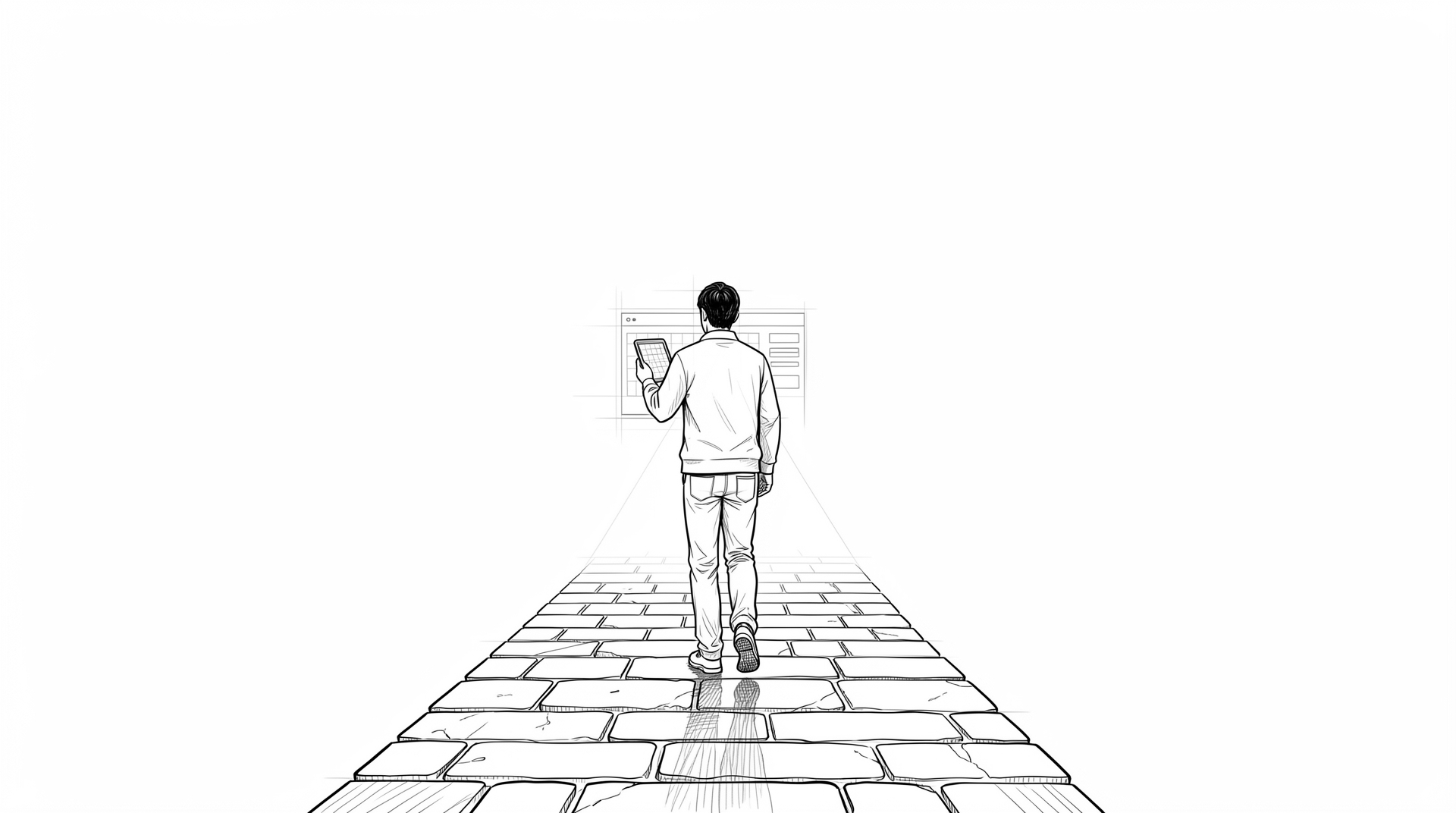
There was a time when the path ahead was legible. You finished school, you found work, you built something slowly. The progression was linear because life moved at a pace that allowed linearity. Each step was visible from the last. You could plan because the terrain held still long enough to be planned against.
Technology changed the terrain.
Not suddenly — gradually, then all at once. The introduction of networked tools, then smartphones, then platforms that knew what you wanted before you did. Each wave compressed the timeline. What once took a decade took a year. What took a year took a quarter. The path got shorter and shorter until it stopped being a path at all and became something more like a fog.
The fog is not a failure of vision. It is a property of the new environment.
When change was slow, you could see far ahead because the future resembled the present. When change becomes exponential, the future stops resembling anything you have seen before. The horizon is no longer a fixed point — it moves as you move toward it. Planning becomes less about knowing where you are going and more about developing the capacity to navigate without knowing.
This is disorienting. It is also, if you can sit with the discomfort, clarifying.
The linear path offered certainty at the cost of range. You knew where you were going, which meant you were largely committed to getting there. The fog offers uncertainty in exchange for something more valuable: optionality. When the path is unclear, every direction is possible. When every direction is possible, the question shifts from "which route do I take?" to "who do I want to be when I arrive?"
That is a harder question. It is also a more honest one.
The people who thrive in exponential environments are not the ones who can see furthest through the fog. They are the ones who have made peace with not seeing — who have learned to move decisively on incomplete information, to update quickly when new terrain emerges, and to treat uncertainty not as an obstacle but as the medium they work in.
Jumping into the fog is not recklessness. It is the appropriate response to a world where waiting for clarity means waiting forever. The fog is not going to lift.
The question is whether you are going to stand at the edge of it, or jump in.