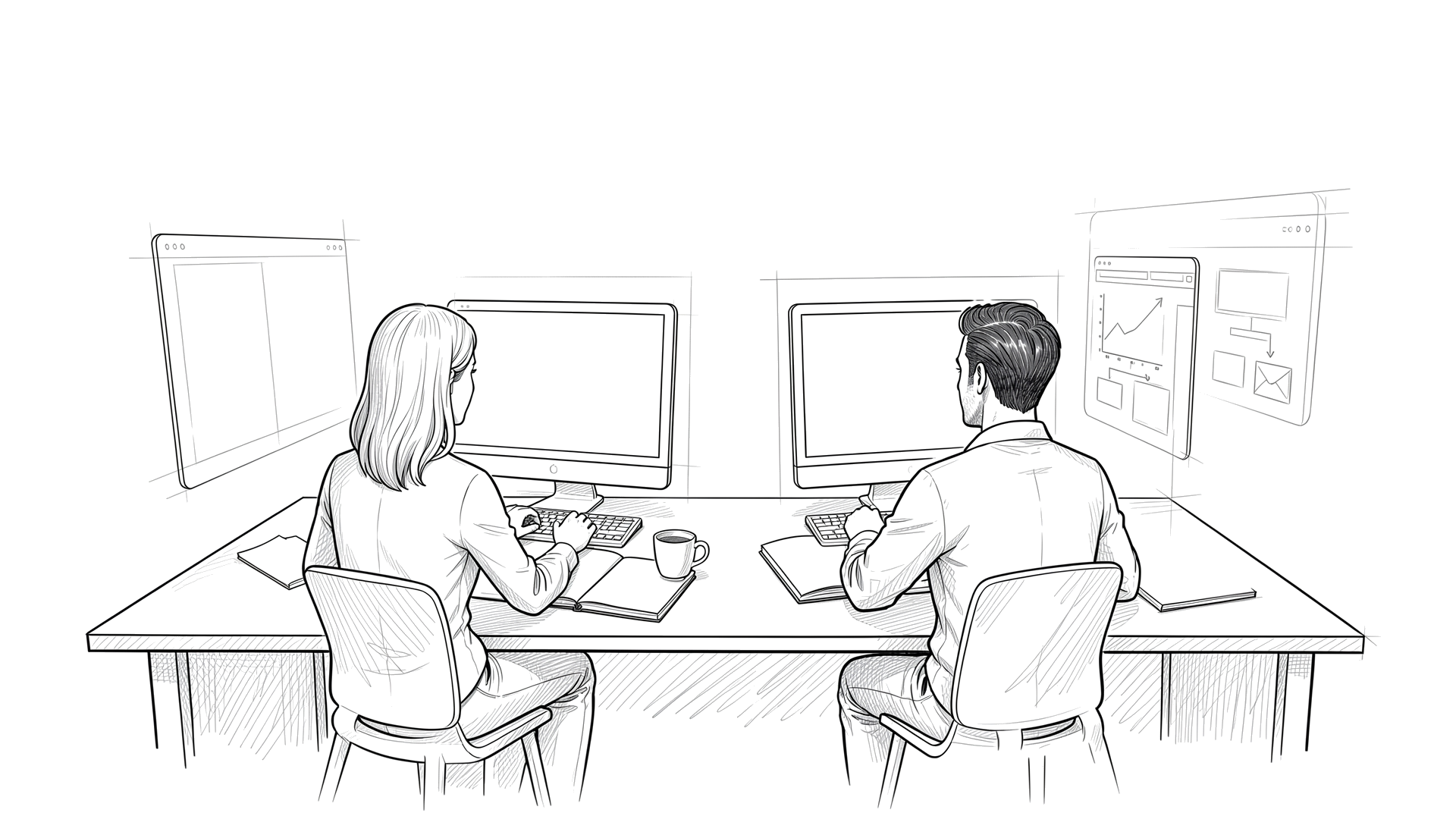
There is a moment, somewhere in the first few weeks of working seriously with an AI agent, when something shifts. It stops feeling like a tool and starts feeling like a presence. It knows how you write. It knows what you care about. It anticipates the next step before you've named it. Philip Pullman called this a daemon — the always-present companion in His Dark Materials, an extension of the self, bound to you, an expression of who you are. Not a pet. Not a servant. Something closer than either.
Most people who have crossed that threshold don't talk about it much, because it sounds strange. But it isn't strange. It's the beginning of a new working relationship — one that will define how knowledge work gets done over the next decade.
The unit of work has changed.
For most of the last century, the knowledge worker was the unit. One person, one inbox, one set of skills, one output. You were measured by what you could produce — the report you wrote, the deck you built, the decisions you made. Your capacity had a ceiling, and that ceiling was roughly the number of hours in your week.
That ceiling is gone.
You are not an individual contributor anymore. You are a person and agent working as one. What that combination can produce in a week would have taken a small team twelve months ago. The leverage is real, and it compounds. The better you get at directing your agent — at specifying what good looks like, at reviewing output with a sharp eye, at iterating quickly — the more the gap widens between you and anyone still working alone.
This is the personal +1. Your agent. Your workflow. Your voice, extended.
The shape of a working day has changed — not in the way that sounds obvious. The change is structural. A well-directed agent doesn't remove the hard work; it relocates it. The hard work is now at the front: defining precisely what you want, what good looks like, what the standard is. And at the back: reviewing output with the eye of an editor, not an approver. The middle — execution, logistics, first drafts, data processing — has largely moved to the agent.
What this looks like in practice: you specify the task clearly enough that nothing is ambiguous. The agent executes. You review — not as a rubber stamp, but as a genuine quality gate. Often you run a second pass with a reviewer agent checking the first agent's work, the way a maker and an editor produce better results than either alone. The agent catches what you missed; you catch what the agent assumed. The loop between thinking and doing compresses to almost nothing.
The tools that have embedded this most deeply don't present AI as a separate tab or a chatbot you switch to when stuck. They put the agent inside the work surface — suggestions inline, context always present. The experience is less like using a tool and more like having a collaborator who is always paying attention.
Every new form of work creates a social question nobody thought to ask in advance. The factory floor created questions about hours and physical safety — questions that took decades to resolve and left permanent marks on how organisations are structured. The office created questions about hierarchy and autonomy: who decides, who defers, and what you owe the institution in exchange for a salary. The remote era created questions about presence and trust: how do you know someone is doing the work if you can't see them doing it?
Each time, the technology arrived first. The social contract followed, slowly, negotiated through friction.
The agent era is no different. Except this time, the question isn't about you and your +1. It's about the structure you're operating inside — and most people haven't looked at it yet.
That structure has three layers. Most people only know about one.
Consider a team of thirty people — engineers, designers, writers, editors, salespeople, customer success — running six software products. Not a future scenario. This is already happening at companies operating at the frontier of agent tooling. What makes these teams distinctive isn't better technology. It's that every person, regardless of role, uses agent environments as a primary work surface. Not a tool they reach for occasionally. The place where work happens. Non-technical staff operating inside the same environments as engineers. The personal +1 isn't an experiment or an enhancement. It's the unit.
Spend time around teams like this and something becomes visible that isn't obvious from the outside: the individual agents are only part of the picture. The team has also developed, organically and often without naming it, a second layer. A shared context. How this team operates. The standards it holds. The shortcuts it has agreed on. The institutional memory of how decisions actually got made — not the policy version, the real version. Call it the work +1. It belongs to the group, not the individual.
And above that sits a third layer: the corporation +1. The company's intelligence, encoded and operationalised. Its brand, its voice, its standards. The accumulated knowledge of how the company wants to present itself, make decisions, and treat its people — expressed not as a policy document but as an active layer in how work gets done.
Most people working with personal agents today are aware of the first layer and vaguely aware that companies will develop the third. Almost nobody is thinking about the second.
That is a mistake.
When people hear "the company has an agent layer that governs your work," the instinct is surveillance. A digital manager looking over your shoulder, flagging deviations, optimising for compliance.
That is the wrong frame.
When a writer joins a publication, they don't start from a blank page. They inherit the publication's voice, its editorial standards, its relationship with readers. Those standards aren't a cage. They're the thing that makes the writer's work legible as part of something larger than themselves. The reader trusts the publication. The publication earns that trust through consistency. The writer's job is to bring their own voice to work within that consistency — not to abandon it.
The corporation +1 is that same thing, encoded into the agent layer. It carries the brand, the voice, the taste. When your personal +1 produces something, the corporation +1 is what makes sure it still sounds like the company — not a generic output, not a deviation, but recognisably yours and theirs simultaneously.
This only works well when the person doing the work understands those standards. When the guardrails are understood. The personal and organisation contract. The question worth asking — the one that separates a coherent organisation from a controlled one — is not whether the corporation +1 exists. It will exist regardless. The question is whether you and your +1 can influence it and operate within the guardrails.
Which brings us to the layer nobody is governing.
The work +1 — the team-level agent — sits between the personal and the corporate. It is neither yours nor the company's. It holds the shared context of how your team actually operates: the norms you've developed, the shortcuts you've agreed on, the standards that exist in practice rather than policy. It is, in many ways, the most accurate picture of how work really gets done.
And it has no contract.
Think about what happens when a strong team member leaves. In the old model, their knowledge walks out with them — their judgment, their shortcuts, their sense of what good looks like. The team feels the gap. Over months, it refills: a new person joins, learns the norms through proximity, eventually builds the same implicit understanding. Institutional knowledge reconstructs itself slowly, through human presence.
The work +1 changes that calculus in ways nobody has fully worked through. The departing team member's contributions don't walk out the door — their corrections, their judgment calls, their influence on how the shared agent learned to operate are embedded in the middle layer. That context persists. Which raises a question that sounds simple and isn't: does it belong to the person who helped build it, or to the team that continues without them?
The inverse is equally unresolved. When a new colleague joins, how do they inherit the work +1? Traditionally, onboarding was human — mentorship, observation, gradual immersion in how things actually work. The work +1 could compress that process significantly, if anyone has thought about how to introduce a new person to the shared context rather than just handing them the tools. Most teams haven't.
When the work +1 and a personal +1 disagree — when the team's standards and an individual's preferences point in different directions — whose judgment wins? There is no policy for this. There is no precedent. There is barely even a language for the question.
The personal +1 is yours. The contract is clear: you own it, you direct it, you are responsible for what it produces.
The corporation +1 is the company's. That contract is also relatively clear, even if the terms weren't negotiated equally: the company sets the standards, the agent guides your work within them.
The work +1 sits between those two contracts, governed by neither. It is the most human layer — built from the actual texture of how a group of people work together — and it is the least examined.
Your work +1 is already forming.
Is your team shaping it together — or just letting it happen?